Caring for Your Body When Life Is a Lot
Oct 08, 2026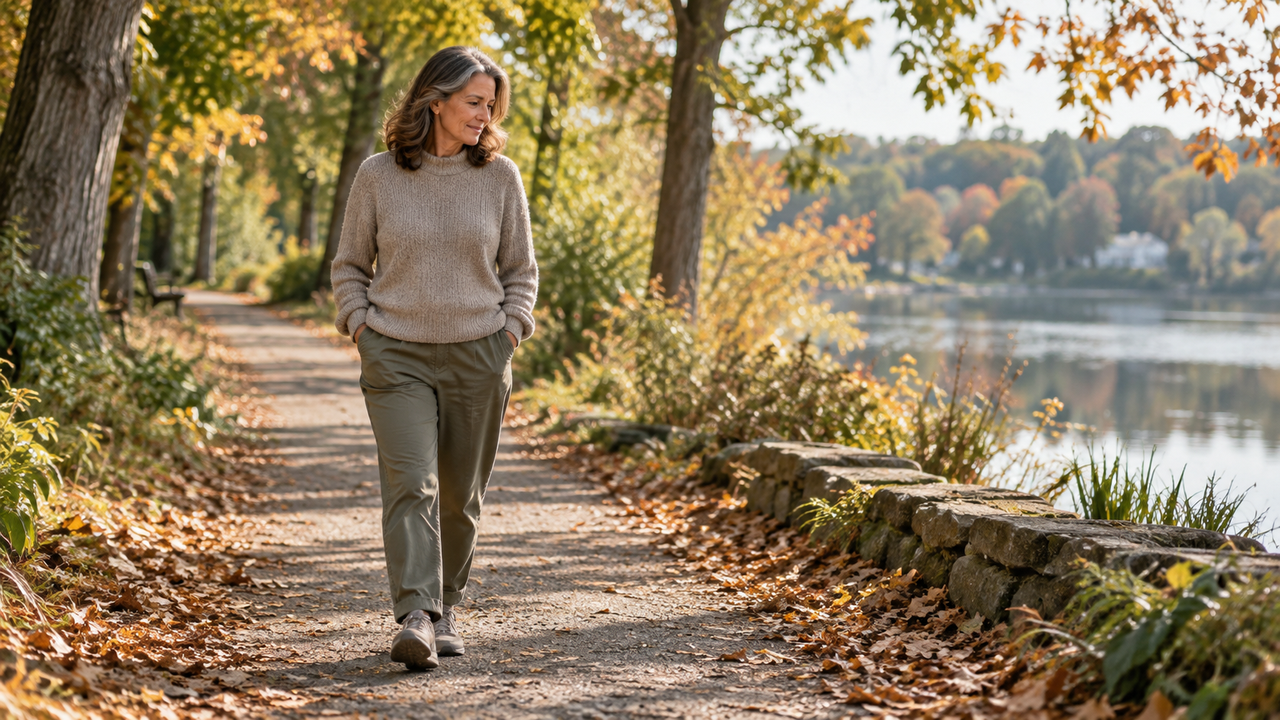
When everything feels like too much
Midlife often brings more to carry. Many of us are caring for aging parents, still showing up for our adult children, and holding things together at work and at home. We want to take care of our health, but there often isn't enough time, energy or emotional bandwidth left over to make it a priority.
This is where an all-or-nothing voice often shows up: If I can't do the workout I'm supposed to do, what's the point? If I can't eat the way I'm supposed to, why bother? And then not doing the "best" thing turns into one more way we feel like we're failing.
So I want to offer something different. In a hard season, you don't need the optimal plan. You need movement and nourishment that help you feel a little more steady in your body. That's it. That's the goal.
Why "optimal" isn't the goal right now
Your body doesn't keep separate accounts for different kinds of stress. Worry, grief, caregiving, poor sleep, hormonal shifts and hard workouts all draw on the same stress-response system. When that system is already running hot, piling on more demand doesn't make you stronger. It just makes you more tired.
That's why the plan that works in a calm season isn't always the right plan in a hard one. Choosing gentler movement right now isn't falling behind. It's matching what you do to what your body actually has to give.
And the good news: movement really does help with stress. A large 2023 review of more than 1,000 trials found that physical activity meaningfully reduced symptoms of depression, anxiety and psychological distress. Every type helped, including walking, strength training, Pilates and yoga, and short programs worked as well as or better than long ones (Singh et al., 2023). You don't need a perfect plan for movement to make a difference.
Movement that helps when you're overwhelmed
In a hard season, the best movement is whatever helps you feel a little more settled in your body. A few places to start:
- Walking, especially outside. No tracking, no pace goals. Just moving and breathing.
- Restorative yoga or gentle stretching. In the 2023 review, yoga and other mind-body practices were among the most effective for anxiety (Singh et al., 2023).
- Dancing to music you love. In the kitchen counts.
- Easy swimming or cycling. Rhythmic, repetitive movement can be soothing.
- Strength training, if it steadies you. For me, lifting is calming. It helps me feel grounded and capable when everything else feels out of control. If that's true for you too, keep it. Just let it be about how it makes you feel, not hitting a number.
Five minutes counts. If all you have is a walk to the mailbox and back, or a few stretches before bed, that's not nothing. That's you taking care of yourself on a hard day.
Try "movement snacks." You don't have to fit movement into one block of time. A 5- to 10-minute walk two or three times a day, a few stretches between tasks, or one song's worth of dancing all add up. Research shows that health benefits are similar whether you move in short bouts spread across the day or in one longer session (exercise snacks review; Paluch, via MDedge).
Short bouts can help in the moment, too. In one small study, a single 10-minute walk was followed by an immediate drop in self-reported anxiety and low mood (Pain Medicine, 2010). The research on mental health and short bouts is still early, but this is something you can test for yourself: next time you feel overwhelm rising, step outside for ten minutes and see what shifts.
Movement snacks are especially helpful when your focus is scattered or a full workout feels like too much. They lower the bar to getting started, and that's often the hardest part.
Move with someone. A walk with a friend, a neighbor or your partner does double duty: you get the movement and the connection. Talking while you walk can make hard things feel a little lighter, and knowing someone is waiting for you makes it easier to show up on days when motivation is low. Research on outdoor walking groups found they were linked to lower depression scores, and most people stuck with them (Hanson & Jones, 2015). If getting together in person isn't possible, a walk while you're on the phone with someone counts too.
What to set aside for now
High-intensity interval training (HIIT), punishing bootcamp classes and "no pain, no gain" workouts are real physical stressors. Higher-intensity exercise is linked to a bigger rise in cortisol, while short, low-intensity exercise barely moves it (Soslu et al., 2023). In a good season, that short-term stress is part of how your body adapts and gets fitter. When you're already depleted, it's one more load on a system that's maxed out.
This doesn't make intense exercise bad. In research, more vigorous activity is often linked to bigger improvements in mood (Singh et al., 2023), and some people find a hard workout is exactly the release they need. It's just not something you have to do right now, and if it leaves you wiped out or more on edge, it's okay to set it down for a while. It'll still be there when you have more to give.
Let your body be the guide
There's no master list of "good" and "bad" workouts for a hard season. The most reliable guide is how you feel afterward. About an hour after you move, check in:
- Do I feel calmer, clearer, or a little more like myself?
- Or do I feel wired, drained, or more on edge than before?
If it's the first, that movement is working for you right now, whatever it is. If it's the second, try something gentler next time. Your answer might change from week to week, and that's normal too.
Eating when you're overwhelmed
Stress changes how we eat, and it doesn't change it the same way for everyone. Intense stress tends to shut appetite down. Longer-running stress affects people differently: an estimated 30% of people eat less than usual, while most eat more. The same stress-response system that governs how we handle pressure also helps regulate hunger, which is why the two are so tangled together (EUFIC; review of stress and appetite).
Both responses are normal. Neither one is a character flaw.
If you find yourself eating more. Reaching for food when you're stressed is your brain trying to find comfort during a hard time, and research suggests comforting foods may genuinely ease the stress response in the moment (EUFIC). The shame that often follows usually hurts more than the food ever did. A few gentle ideas:
- Skip the "making up for it." No skipping the next meal, no extra workout. Just go back to eating normally.
- Eat regular meals. Going long stretches without food can make eating feel more urgent later.
- Let comfort foods be part of your eating, without guilt. Interestingly, people who usually restrict their food tend to be more prone to stress eating, not less (EUFIC).
If you lose your appetite. For me, it's this one. When I'm overwhelmed, I just can't eat, and then I wonder why I feel shaky, weak and exhausted. Your body still needs fuel even when it isn't asking for it. A few ideas:
- Go small and frequent. A few bites every few hours is easier than a full meal.
- Drink some of your nourishment: a smoothie, soup, milk or a protein shake.
- Keep easy foods within reach: yogurt, cheese and crackers, toast with peanut butter, a banana.
- Eat by the clock for a while if hunger cues have gone quiet. A gentle phone reminder can help.
Emotional eating is a bigger conversation, and it deserves more space. I'll come back to it in depth another time. For now, just know that whatever your body is doing with food right now, it's trying to help you cope.
Rest counts too
Perimenopause and stress can both disrupt sleep, and a short night makes everything else feel harder, from motivation to appetite to patience. You can't force sleep, but you can make room for rest: a slower evening, a few minutes of stretching or breathing before bed, putting the phone down a little earlier. On days when sleep doesn't come, gentle movement is a better choice than pushing through a hard workout. If sleep problems keep going, they're worth bringing up with your provider.
When to reach for more support
Movement and nourishment can help a lot, but they're not meant to carry everything. It's worth talking with a therapist, your doctor, or someone you trust if:
- The overwhelm or anxiety isn't easing, or it's getting in the way of daily life
- You're having trouble eating for more than a few days, or eating feels out of your control
- You're exhausted no matter how much you rest
- Sleep problems keep going
Asking for help isn't a sign you're not handling things. It's part of handling them.
Something to notice
This week, pay attention to the voice that says what's the point when you can't do things the "right" way. What does it tell you about what counts? And what happens when you let a walk, a stretch, or a few bites of something easy count too?
There's no right answer here. Just notice what comes up.
Sources
- Singh B et al. Effectiveness of physical activity interventions for improving depression, anxiety and distress: an overview of systematic reviews. Br J Sports Med, 2023.
- Soslu R et al. Effects of high-intensity interval training program on pituitary function in basketball players: a randomized controlled trial. Front Physiol, 2023 (background summary of exercise intensity and cortisol).
- Effects of exercise snacks on fitness and cardiometabolic health in physically inactive adults. Br J Sports Med.
- Bite-sized bouts of exercise: why they are valuable and what they are missing. MDedge, 2022.
- Immediate benefits of a brief 10-minute exercise protocol in a chronic pain population: a pilot study. Pain Med, 2010.
- Hanson S, Jones A. Is there evidence that walking groups have health benefits? A systematic review and meta-analysis. Br J Sports Med, 2015.
- European Food Information Council. Stress and food intake.
- Neurohormonal regulation of appetite and its relationship with stress: a mini literature review. PubMed Central.
This article is for educational purposes and isn't a substitute for personalized medical or mental health advice. Please talk with your healthcare provider about what's right for you.